12 Days. Three Major Events. One Unanswered Question.
By Valvettithurai Intel Desk
September 18, 2026
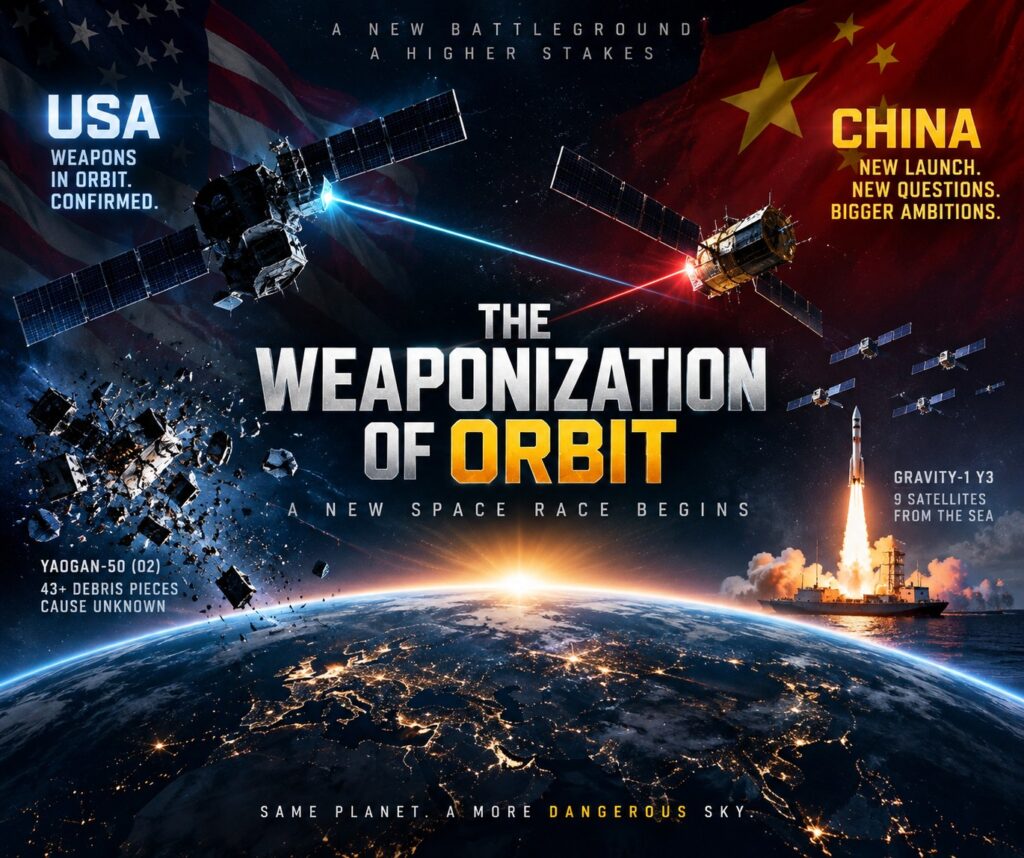
Space has long been militarized — surveillance, navigation, and communications satellites have supported military operations for decades. But over 12 days in September 2026, three significant developments brought the changing strategic environment in orbit into sharper focus.
Are these events connected? We do not know. But here is exactly what is confirmed, what remains unclear, and why the timing matters.
1️⃣ THE SILENT BREAKUP — September 4, 2026
Confirmed:
- China’s Yaogan‑50 (02) satellite broke apart in orbit
- More than 43 pieces of debris are being tracked by U.S. Space Force 18th Space Defense Squadron
- Debris distributed across roughly 600 km to 1,100 km altitude
- The satellite occupied an unusual highly retrograde orbit — rare and analytically notable
- Yaogan series satellites are widely identified by independent Western analysts as having military reconnaissance and surveillance roles
Not confirmed:
- Official cause remains unexplained. No statement from CASC or Chinese authorities
- Possible scenarios: propulsion/battery anomaly, collision with untracked debris, or deliberate action — none have been independently verified
- Jonathan McDowell notes debris velocities suggest a relatively low‑energy fragmentation, not a violent kinetic impact
Source: SpaceNews / Space4Peace — Sept 4, 2026
2️⃣ THE HISTORIC ACKNOWLEDGMENT — September 14, 2026
Confirmed:
- Speaking at the Air & Space Cyber Conference, U.S. Air Force Secretary Troy Meink stated on the record: “The Space Force now has on-orbit space control weapons capable of defending the joint force against hostile adversary action.”
- This was the first explicit public confirmation by a U.S. official that the country has on-orbit space‑control weapons.
- Meink deliberately declined to provide specifics: no dates, locations, numbers, and refused to confirm whether systems are kinetic or non‑kinetic
- He confirmed the wording was “very well thought out” and intentional
- Noted accelerated development of Space‑Based Interceptor and Space‑Based AMTI constellations under the Golden Dome missile defense program
- Named China and Russia as advancing their own counter‑space capabilities
Source: Air & Space Forces Association — Sept 14, 2026
3️⃣ DIPLOMATIC WARNING & SEA LAUNCH — September 15–16, 2026
September 15 — Diplomatic reaction:
- Chinese Foreign Ministry spokesman Guo Jiakun stated: “We urge the U.S. side to stop expanding its military capabilities and preparing for war in outer space.”
- This statement came before the Gravity‑1 launch
Source: Channels Television — Sept 15, 2026
September 16 — Sea launch:
- Gravity‑1 Y3 lifted off at 06:00 Beijing Time from a mobile platform in eastern waters off Shanghai
- Delivered nine satellites to ~800 km orbit:
- ✅ 8 × Qianfan broadband communications satellites
- ✅ 1 × EUHT technology test satellite — publicly described as an ultra‑high‑speed communications demonstrator
- Framed officially as the world’s first sea‑launched broadband megaconstellation mission
Source: GMTEight — Sept 16, 2026
What is not yet clear:
- Detailed technical capabilities, operational scope, and full mission profile of the EUHT satellite have not been publicly disclosed
- No official link has been established between the September 14 U.S. announcement and the September 16 launch — close timing is observable; a causal link has not been proven
🔍 ANALYSIS — What We Can Say
Table
| Observation | Assessment |
|---|---|
| Compressed timeline | Three significant events in 12 days is notable. This does not prove coordination or direct response — but it invites scrutiny. |
| Transparency gap | Both sides are making high‑level strategic statements while disclosing minimal technical or operational detail. |
| Mobile launch capacity | Sea‑based launch offers operational flexibility compared to fixed land sites — a demonstrated capability whose full strategic application remains unstated. |
| Long‑term context | Anti‑satellite tests, military constellations, and counter‑space research have existed for decades. What is new is public acknowledgment of deployed orbital weapons. |
⚖️ BOTTOM LINE
- The United States has publicly confirmed it possesses on‑orbit space‑control weapons — a historic shift in transparency and posture
- A Chinese military‑associated satellite has broken apart without confirmed cause or official explanation
- China has issued a formal warning, then launched new payloads including one with limited public mission details
- Officials from both sides have exchanged warnings about conflict in space
These events may be coincidental. They may be connected. The evidence we have so far does not settle the question.
What is certain: space is no longer viewed as a background domain — it is increasingly central to global strategic competition. How this plays out will depend as much on what is not said as what is.
Leave a Comment