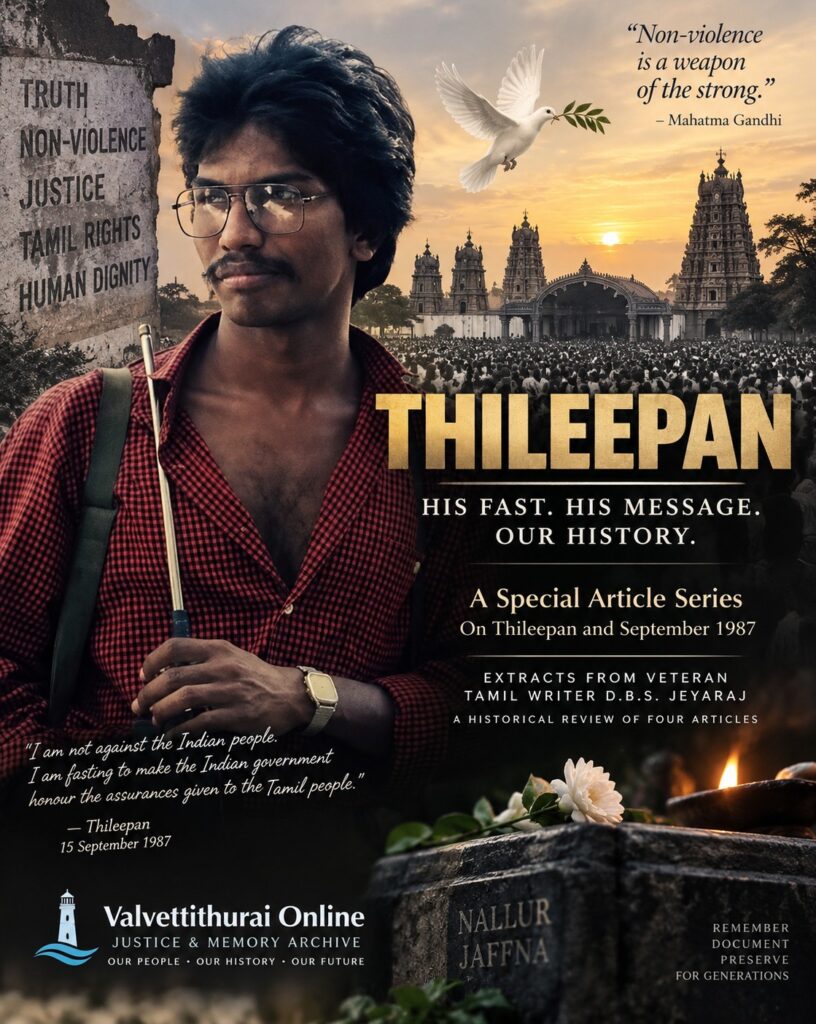
A Historical Review of Four Articles on Thileepan’s Fast Unto Death — September 1987
Published: 13 September — Two Days Before the Commencement of the Fast
About D.B.S. Jeyaraj — The Writer and His Work
D.B.S. Jeyaraj is one of the most prolific and widely read writers on Sri Lankan Tamil affairs and the history of the Tamil struggle. For decades, his articles have appeared in multiple publications and online platforms, offering detailed accounts of people, events, and political developments that have shaped the modern history of the island.
He is also, without question, a controversial figure. Sections of the Tamil community have disagreed strongly with his analyses, interpretations, and judgements. At various times, persons associated with the LTTE — including some in senior positions — have criticised him publicly and privately. He has been accused of bias, of misunderstanding the movement, and of failing to see events through the eyes of ordinary Tamils. These disagreements are real, and they should be acknowledged. They do not, however, make his work worthless.
Whatever one may think of his perspectives, Jeyaraj possesses qualities that make his writing an indispensable historical resource:
- His articles are exceptionally detailed, often containing precise dates, timelines, names, places, and sequences of events that are difficult to find elsewhere.
- He has maintained access to a wide range of persons — political actors, movement insiders, diplomatic sources, and eyewitnesses — whose accounts do not generally appear in mainstream media.
- He publishes extensive chronology, documentary references, and political context alongside his commentary, allowing readers to see the evidence alongside his interpretation.
- Even where readers disagree with his conclusions, the factual material he sets down remains a valuable record that can be cross-checked against other sources.
This article is not an endorsement of D.B.S. Jeyaraj’s views. It is a review and synthesis of four substantial articles he has written on Thileepan, supplemented and cross-checked wherever possible with other historical records and the primary text of the Indo–Sri Lanka Accord itself.
Editorial Methodology:
- Where something is a documented fact, it is presented as such.
- Where it is Jeyaraj’s interpretation, this will be made clear.
- Where other sources differ, those differences will be noted.
- Where we simply do not know, it will be admitted openly.
The Four Articles Reviewed
This review draws upon four major articles published by D.B.S. Jeyaraj at dbsjeyaraj.com:
1.Tiger Leader “Thiyagi” Thileepan Weaponised Non-Violence Through his Fast Unto Death in September 1987 — September 2023
→ Political strategy of the fast, the five demands, and non-violence as a deliberate instrument
2.Remembering the Tiger “Martyr” Thileepan on his 36th Death Anniversary — September 2023
→ Biography: upbringing, education, personal character, and early years in the movement
3.Thileepan’s Fast Touched the Spirit of the Tamil Nation and Mobilised Masses in Unprecedented Solidarity — September 2022
→ Day-by-day unfolding, public response at Nallur, and emotional impact upon the Tamil people
4.Indo–Lanka Accord, Thirteenth Amendment and the Tamil March of Folly — January 2022
→ The broader Accord framework, India’s formally guaranteed undertakings, diplomatic failures, and the causal chain leading to LTTE–IPKF conflict
Together, these four articles provide a comprehensive account: who Thileepan was, why he fasted, what he demanded, how the people responded, what India did — and what followed afterwards.
Who Was Thileepan?
Rasiah Parthipan — known universally by his nom de guerre Thileepan — was born on 29 November 1963 in Urelu, Jaffna. He was the youngest son of a respected schoolteacher; his mother died when he was an infant, and he was raised and educated by his father. He studied at Jaffna Hindu College, one of the oldest and most prestigious schools in the peninsula.
He joined the Liberation Tigers of Tamil Eelam (LTTE) before the anti-Tamil pogrom of July 1983. Unlike many early members, he did not rise through military reputation alone. He became known for his character: articulate, approachable, disciplined, and deeply concerned with the relationship between the movement and the civilian population. He edited publications, listened to grievances, and represented the LTTE publicly.
Following serious injuries sustained in the Vadamarachchi Operation of May 1987, Thileepan was appointed LTTE Political Commissar and Jaffna District Political Leader — effectively the movement’s public face in Jaffna. LTTE leader Velupillai Prabhakaran conferred upon him the rank of Lieutenant Colonel.
Jeyaraj records that Thileepan occupied a unique position: trusted by the leadership, yet also trusted by the people. He moved among the public, spoke their language, and was seen as someone who genuinely cared. It was this standing — his moral authority in the eyes of ordinary Tamils — that would make his fast so powerful.
Historical Context: The Indo–Sri Lanka Accord of July 1987
To understand why Thileepan fasted — and why he fasted against India — it is necessary to understand the legal and political obligations India had assumed under the Indo–Sri Lanka Accord of 29 July 1987.
The Accord was signed by Indian Prime Minister Rajiv Gandhi and Sri Lankan President J.R. Jayewardene. Critically, the Agreement explicitly stated in Clause 2.14:
“The Government of India will underwrite and guarantee the resolutions, and co-operate in the implementation of these proposals.”
India had formally guaranteed the settlement. The Indian Peace Keeping Force (IPKF) was subsequently deployed pursuant to the Accord and its Annexure, in connection with the cessation of hostilities, arms surrender and the implementation of the agreement. Among those undertakings: the Northern and Eastern Provinces were recognised as areas of historical Tamil habitation; security forces were to be confined to barracks; and a general amnesty was to be granted to all Tamil detainees.
By mid–September 1987, barely six weeks later, none of these key guarantees had been fulfilled. State-aided settlement in Tamil lands continued; detainees remained imprisoned; new security posts were established; and the IPKF appeared to be policing Tamils rather than safeguarding them.
This is why Thileepan directed his demands to the Government of India, not to the Government of Sri Lanka. He was not protesting the Accord. He was holding India to India’s own written guarantee under Clause 2.14. Delhi had undertaken the responsibility. Delhi had given the guarantee. Thileepan simply asked: keep your promises.
The Five Demands — Verified Against the Accord Text
On 13 September 1987, Thileepan handed a formal letter to the Indian High Commissioner in Jaffna, setting out five minimum demands and requesting a response within 24 hours. These demands are recorded consistently across Jeyaraj’s writings and in contemporary Tamil sources. When examined against the actual text of the Indo–Sri Lanka Accord, they are not new or extreme demands — they are requests that India implement the commitments it had already undertaken to guarantee:
1. Cease Sinhalese colonization of traditional Tamil lands in the North and East under the cover of rehabilitation and resettlement
→ Grounded in Clause 1.4 (North–East recognised as “areas of historical habitation of Sri Lankan Tamil speaking peoples”) and Clause 2.16(e) (joint Indian–Sri Lankan responsibility for physical security), both underwritten by India under Clause 2.14. Tamil leadership viewed state-aided settlement schemes such as Manal Aru/Weli Oya as altering demographic composition prior to the promised referendum.
2. Release all Tamil detainees held without charge under the Prevention of Terrorism Act (PTA) and Emergency regulations
→ Direct citation: Clause 2.11 explicitly mandated: “The President will grant a general amnesty to political and other prisoners now held in custody under the Prevention of Terrorism Act and other Emergency laws.” India formally guaranteed implementation under Clause 2.14. By mid–September, this amnesty had not been granted.
3. Establish an Interim Administrative Council for the merged North–Eastern Province with LTTE representation, to oversee governance prior to elections
→ Diplomatic record, not a formal Accord clause: This was the central subject of confidential negotiations between Indian High Commissioner J.N. Dixit and LTTE leader Velupillai Prabhakaran during August–September 1987. India had agreed in principle to an interim administration with LTTE predominance. Implementation stalled due to objections from Colombo.
4. Stop new Sri Lankan Army and Police camps in Tamil areas; vacate schools and public buildings occupied by security forces
→ Principal Accord basis: Clause 2.9, which explicitly required security forces to be confined to barracks as they stood on 25 May 1987. In practical terms, restoring that status quo required vacating schools, colleges, and public premises that had been requisitioned during military operations leading up to that date.
5. Disarm and withdraw state-armed Home Guard units operating in Tamil areas; bring all state-backed militias under IPKF supervision
→ Grounded in Clause 2.9 (surrender of arms and confinement of security forces) and Clause 2.16(e) (joint Indian–Sri Lankan responsibility for physical security). Home Guards, armed and operating in the Eastern Province, were never disarmed or confined, placing Tamil civilian communities at continued risk.
When no satisfactory reply was received, Thileepan announced his decision: he would fast unto death until the Government of India fulfilled its own written guarantees.
Note: Every clause cited above has been cross-verified against the full text of the Indo–Sri Lanka Accord of 29 July 1987, published by the Ministry of External Affairs (Government of India), the United Nations Peacemaker archive, and the Sri Lanka Secretariat for Coordinating the Peace Process. Where a demand rests upon diplomatic negotiations rather than the printed Accord text, this distinction is clearly stated. Where practical application is inferred from the text, that distinction is also noted.
The Fast as Political Action — “Weaponised Non-Violence”
On the morning of 15 September 1987, Thileepan took his seat on a raised platform erected at the Nallur Kandaswamy Temple in Jaffna — one of the most sacred and revered places of worship for Tamil people worldwide.
He declared clearly:
“I am not fasting against the Indian people. I am fasting to compel the Government of India to honour the assurances given to the Tamil people.”
There are three aspects of this decision that deserve careful examination:
He chose non-violence. In a conflict defined by armed struggle, Thileepan reached instead for the oldest moral weapon in Indian political tradition: fasting. He drew upon the legacy of Gandhi — the idea that moral authority can compel power where force cannot. This was not an act of surrender. It was a strategic choice: to place the might of the Indian state against the conscience of one man, and see which would yield.
He refused water. Most significantly: Thileepan refused both food AND water. This was not a detail. It was a deliberate political calculation. A fast with water can last weeks. A fast without water can be measured in days. He chose severity so that Delhi could not simply wait him out. He forced an immediate crisis. He gave India days to act — or to watch him die.
He targeted the State, not the People. Thileepan was careful to distinguish between the Government of India and the people of India. He did not attack India. He appealed to India’s own values — to justice, to honour, to the very principles of non-violence that India claimed to uphold. This distinction remains important today.
The Central Historical Question
There is one question that stands above all others in this history. It is the question that this series will examine day by day, drawing upon all available evidence:
Why did the Government of India fail to bring the fast to an end before Thileepan died?
From the material reviewed so far, the following accounts are recorded:
- The Indian government viewed the fast as an LTTE bargaining tactic rather than a genuine moral protest.
- Communications passed back and forth between Thileepan, the LTTE leadership, and Indian representatives.
- At one stage, India requested a written guarantee from LTTE leader Velupillai Prabhakaran that Thileepan would end the fast if negotiations began.
- According to Jeyaraj, Prabhakaran declined to provide that guarantee.
- No agreement was reached. No concession was made. Thileepan continued.
These are the accounts currently before us. Why Prabhakaran refused — whether he believed India would still yield, whether he could not bring himself to intervene, or whether there were other considerations — remains a matter of historical dispute. Why India refused to negotiate the five demands — whether they believed the LTTE was bluffing, whether they calculated his death would weaken the movement, or whether other considerations prevailed — is also a matter of differing interpretations.
This opening article does not attempt to answer that question. It is the question itself that we must carry with us as we return day-by-day to the events of September 1987.
The Tamil Experience — Grief, Solidarity and Betrayal
As the days passed, something extraordinary happened. The fast at Nallur became more than one man’s protest. It became a collective experience of the Tamil people.
Life across the North–East came to a standstill. Hundreds, then thousands, travelled to Nallur Temple. They came to pray, to stand in solidarity, to witness. Flowers and offerings surrounded the fasting leader. People wept. People fasted alongside him. Others began parallel fasts in their own towns and villages. There was fear, and there was hope — hope that India would listen, that justice would be done, that the promises would be kept.
When Thileepan died on 26 September 1987 — after eleven days without food or water — the hope turned to grief. And grief turned, swiftly, to anger. The IPKF, once greeted as liberators, was now seen as complicit. The written guarantees of Delhi were revealed as empty words. Thileepan’s death did not persuade India to change its policy. It persuaded the Tamil people that India could not be trusted.
It is important to be clear: this anger was directed at the Government of India and its policies, not at the people of India. Thileepan himself insisted upon this distinction. Many Indians — including those who inherited the traditions of Gandhi and non-violence — have their own perspectives on these events. This historical review does not dismiss those perspectives. It simply records what the Tamil people experienced, and why that experience mattered.
The Road Ahead — The Valvettithurai Online Historical Archive Project
This article is only the beginning.
Over the coming two weeks, Valvettithurai Online will publish a day-by-day historical record of Thileepan’s fast — from the final days before he began his protest, through each successive day at Nallur Temple, until his death on 26 September 1987.
This is intended as both commemoration and archival project. Much historical material that was once available online has since disappeared, been removed, or become difficult to locate. This series is also an effort to preserve that history so that future generations may understand what happened, why it happened, and what it meant.
The series will draw upon:
- The writings of D.B.S. Jeyaraj;
- Contemporary Tamil publications and records from the period;
- Books, journals, and independent historical research;
- Archival material, photographs, and visual records where available;
- Reports from international bodies and independent observers.
This year’s research is being assisted by multiple independent analytical systems. These are tools for research and comparison. They do not create history. The principle guiding this work is simple and will be maintained throughout:
AI assists the research. Sources establish the history.
Different systems may identify different sources, different interpretations, or gaps in the evidence. Those differences will be acknowledged openly, not hidden. Where sources conflict, the conflict will be shown. Where evidence is incomplete, it will be stated.
Editorial Principles
This series will not pretend to a false neutrality. It will not erase the experience of the Tamil people. But nor will it manufacture certainty where the historical record remains uncertain.
- Where something is documented fact, it will be stated clearly.
- Where something is interpretation, it will be identified as such.
- Where sources disagree, the disagreement will be explained.
- Where we simply do not know, it will be admitted openly.
The goal is not to prove one side right or another wrong. The goal is to understand what happened, and why — so that we may learn from it.
The Story Continues Tomorrow
Tomorrow, the story moves closer.
We will begin to see the events unfold: the letter delivered to the High Commissioner, the silence from Delhi, the decision to fast, the journey to Nallur.
From that moment, Valvettithurai Online will follow the history step-by-step, day-by-day, exactly as it happened — thirty-nine years ago.
We do this because Thileepan’s fast was more than a sacrifice. It was a moment when the Tamil people looked to a great power for justice — and were refused. Understanding exactly what occurred, day by day, is the only way to understand what followed afterwards: the collapse of the Accord, the war between the LTTE and the IPKF, and the decades of suffering that still cast their shadow today.
This is only the beginning. Tomorrow, we return to Jaffna. September 1987.
Sources Consulted
Four D.B.S. Jeyaraj Articles (dbsjeyaraj.com):
- Tiger Leader “Thiyagi” Thileepan Weaponised Non-Violence Through his Fast Unto Death in September 1987 — Sept 2023
- Remembering the Tiger “Martyr” Thileepan on his 36th Death Anniversary — Sept 2023
- Thileepan’s Fast Touched the Spirit of the Tamil Nation and Mobilised Masses in Unprecedented Solidarity — Sept 2022
- Indo–Lanka Accord, Thirteenth Amendment and the Tamil March of Folly — Jan 2022
Primary Accord Text — Clause-by-Clause Verified:
- Clause 1.4: North–East recognised as “areas of historical habitation of Sri Lankan Tamil speaking peoples”
- Clause 2.9: Security forces confined to barracks as on 25 May 1987
- Clause 2.11: General amnesty for all detainees held under PTA and Emergency laws
- Clause 2.14: “The Government of India will underwrite and guarantee the resolutions…” — India’s formal guarantee
- Clause 2.16(e): Joint Indian–Sri Lankan responsibility for physical security
- Interim Administrative Council: Not in Accord text — subject of Dixit–Prabhakaran negotiations, Aug–Sept 1987
Primary Sources: Indo–Sri Lanka Accord (29 July 1987) — sourced from Ministry of External Affairs (India), United Nations Peacemaker archive, and Sri Lanka Secretariat for Coordinating the Peace Process. Cross-referenced with J.N. Dixit (Assignment Colombo), Anton Balasingham (War and Peace), UTHR(J) reports, and contemporary Tamil press records.
This article has been checked against the primary Accord text and the principal sources identified above. Where the historical record remains disputed or incomplete, the series will say so.