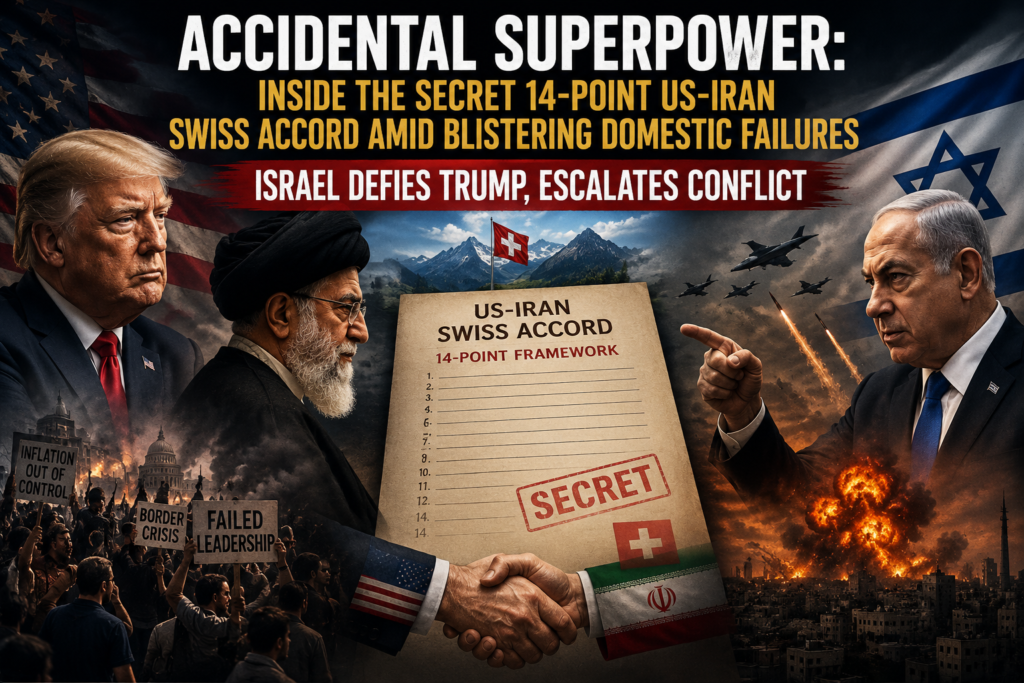
Israel Defies Trump, Escalates Conflict
GENEVA / WASHINGTON — A sweeping, highly confidential 14-point memorandum of understanding (MoU) between the United States and Iran is slated to be officially signed this Friday in Switzerland [02:47]. The diplomatic breakthrough comes as a massive surprise to global observers, revealing a dramatic pivot by U.S. President Donald Trump that critics argue stems from severe domestic and military vulnerabilities rather than strategic leverage.
According to renowned defense analyst Dr. Arush, speaking to independent media outlet Eelam E News, the upcoming Swiss accord represents a profound shifting of the geopolitical tides in the Middle East.
The Leaked 14-Point Framework
While Washington has attempted to keep the exact terms hidden from key allies—most notably Israel [02:09]—details of the draft framework have leaked across international and Iranian media networks. The core tenets of the impending agreement include:
- Global Front Ceasefire: A total cessation of military hostilities across all active conflict zones, explicitly encompassing the United States, Iran, and their respective regional allies, including Lebanon [03:41].
- Nuclear Halts with a Catch: Iran has committed to a freeze on creating or acquiring nuclear weapons [03:41]. However, immediate handover of its enriched uranium stockpiles has been excluded; Tehran is permitted to maintain its current nuclear infrastructure while future terms are negotiated [03:55].
- Hormuz Reopening: Iran must guarantee unhindered and secure passage for commercial shipping vessels through the critical Strait of Hormuz within 60 days [04:19]. President Trump noted that partial shipping lanes will open almost immediately following Friday’s signing [03:14].
- Sanction Relief and Troop Withdrawal: Once a finalized treaty is established, the U.S. will permanently lift all economic sanctions and completely withdraw its military forces from the region within 30 days [04:47].
The $24 Billion Asset Thaw
A pivotal financial mechanism of the deal involves the immediate unfreezing of Iranian capital. Citing the leaked draft of the MoU, the Iranian news agency Mehr reported that the United States has officially promised to unfreeze $24 billion worth of Iranian assets currently held in foreign accounts.
Crucially, the terms dictate that exactly half of this amount—$12 billion—must be fully returned to Tehran before the two nations officially sign the agreement in Switzerland.
Furthermore, the draft outlines a staggering $300 billion reconstruction fund for Iran [04:47]. While President Trump has publicly labeled the $300 billion figure as “fake news” [05:33], Vice President JD Vance clarified that a multi-nation financial management framework is indeed being constructed between Iran and Western coalition forces [05:33].
What Forced Trump’s Hand? A Depleted America
Analysts argue that the White House did not enter these negotiations from a position of strength. Instead, severe economic and military realities forced the administration to seek an immediate exit ramp.
📺 Watch the Full Analysis | வீடியோ அறிக்கை
(Language: Tamil / தமிழ்)
1. The Catastrophic Oil Depletion
According to Bloomberg data, the United States has completely exhausted its emergency oil reserves to keep domestic fuel prices under the $100 mark. U.S. strategic reserves have crashed to a 43-year low, plummeting to levels not seen since 198. With emergency storage tanks hovering at absolute baseline levels [13:35], the U.S. simply could no longer sustain a prolonged blockade of the Strait of Hormuz.
2. A String of Sudden Military Disasters
The diplomatic retreat coincides with an alarming rash of high-profile U.S. military assets crashing worldwide—with over 14 aircraft going down globally in a concentrated window. This includes a devastating crash of a $750 million B-52 strategic bomber just 24 hours after an F/A-18 Super Hornet plummeted. Growing intelligence concerns suggest that sophisticated Iranian hacking syndicates may have compromised and penetrated U.S. military electronic control systems .
“A Crushing Defeat”: The New York Times ran a blistering headline stating that Trump has suffered a “crushing defeat” against Iran . The publication noted that starting an illegal conflict has profoundly weakened the U.S. militarily, diplomatically, and economically, while leaving Tehran as the undisputed strategic victor [15:15]. Prominent military analyst Mike Adams similarly concluded that the U.S. has “accidentally transformed Iran into a global superpower”.
Israel’s Attempted Sabotage and the Lebanon Red Line
The singular nation fiercely opposing the Swiss accord is Israel. Prime Minister Benjamin Netanyahu’s war cabinet has aggressively sought to disrupt the deal for domestic political survival, even demanding that Washington turn over the classified treaty documents—a request President Trump flatly denied .
Reports indicate that Trump recently intervened to block a massive Israeli military operation inside Gaza, threatening to completely sever all U.S. aid if Netanyahu refused to comply. Demonstrating a widening fracture, the U.S. military has already begun evacuating 74 of its aerial refuelling tanker aircraft out of Israel’s Ben Gurion Airport.
The survival of the entire peace deal now hinges on a razor’s edge. Iranian Foreign Minister Abbas Araghchi issued an absolute warning: if Israel launches any further major military incursions into Lebanon, the Swiss peace agreement will be deemed completely null and void that very day.
With Friday’s signing fast approaching, the world watches to see if Washington can successfully chain its closest ally, or if regional defiance will shatter the accord before the ink even dries.