A question has now arisen: is Sri Lanka itself paving the way for such a scenario, despite its repeated assertions that the Indian Ocean region must not become a theater for geopolitical rivalry or military conflict between superpowers?
Recently, while speaking at the Wanshan Forum on Global Security in Beijing, General Shavendra Silva, the former Commander of the Sri Lankan Army, noted that progress for countries like Sri Lanka comes through principled and balanced diplomacy. He also stated that while protecting sovereignty, strategic independence, and national interests, it is essential to maintain constructive relations with all nations.
However, a question remains as to how balanced Sri Lanka’s policy actually is when it comes to its strategy of maintaining equal relations with all countries.
The Indian Ocean as a Zone of Peace
Every single Sri Lankan defense official has repeatedly emphasized that the Indian Ocean region should not get caught up in geopolitical rivalry.
Speaking recently at the 14th International Meeting of High-Ranking Officials Responsible for Security Matters held in Moscow, Secretary of Defence Air Vice Marshal Sampath Thuyacontha emphasized the importance of maintaining the Indian Ocean as a zone of peace, cooperation, and shared prosperity amidst prevailing security challenges.
The concept of maintaining the Indian Ocean as a zone of peace has been a long-standing proposal of Sri Lanka. This idea was first presented to the UN in 1971 by the then Prime Minister Sirimavo Bandaranaike. Although this proposal is now nearly 55 years old, the Indian Ocean region has gradually become more tense from that time until now.
Escalation of Tensions
As a climax to this, in the early hours of March 4th, the Iranian Navy’s IRIS Dena was sunk by an American submarine 19 nautical miles south of Galle. This incident effectively shifted the war happening in the Middle East into the Indian Ocean. Submarines from several countries, including the United States, China, India, and France, had been operating secretly in the Indian Ocean region; now, they move around ready for combat.
Many nations now find themselves in a situation where they must confront an invisible enemy in the Indian Ocean. An environment has been created where it is impossible to predict who will attack, where, or when. This leaves no room for maintaining the Indian Ocean as a zone of peace.
Recent Naval Arrivals in Colombo
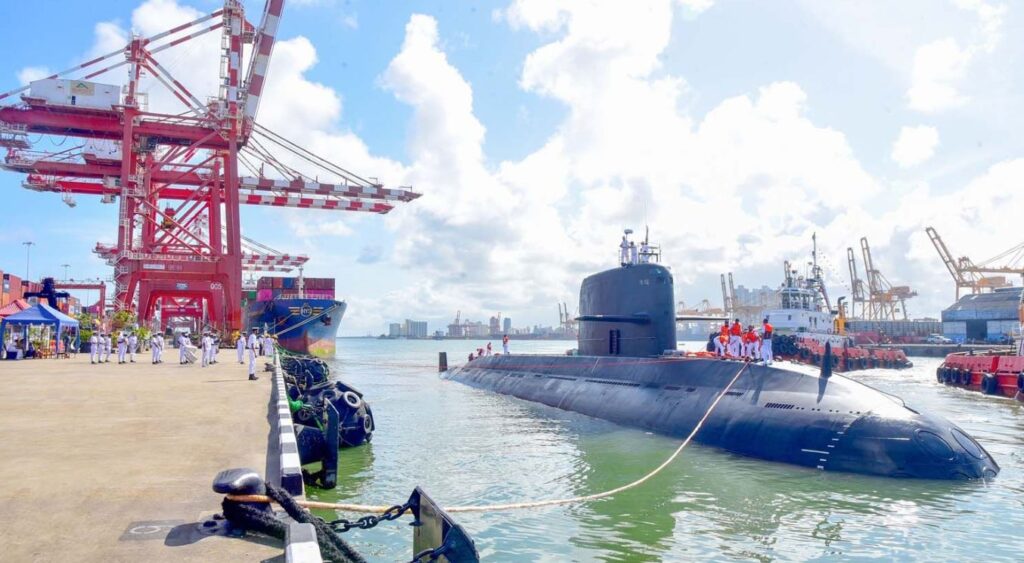
Against this backdrop, last Tuesday, the Pakistan Navy’s submarine PNS Hangor, along with the guided-missile warships PNS Taimur and PNS Aslat, arrived at the Colombo Port. These Pakistani warships arrived in Sri Lanka for replenishment needs and as part of a goodwill visit.
The day before these ships arrived, the Indian Navy’s amphibious landing ship INS Airavat had arrived at the Colombo Port. That ship had come to Colombo Port on a goodwill visit, carrying spare parts required for the patrol vessel Suraksha, which India had previously gifted to the Sri Lankan Coast Guard.
India may have sent this vessel foreseeing the arrival of the Pakistani warships. There is a high probability that information regarding the arrival of the Pakistani warships was shared with India beforehand, because a Pakistani submarine was part of that fleet.
The Significance of PNS Hangor
This submarine, PNS Hangor, was built in China. It was officially commissioned into the Pakistan Navy at a ceremony held at China’s Sanya Port on April 30th. Pakistan President Asif Ali Zardari, the Chief of the Naval Staff of the Pakistan Navy, and other high-ranking officials attended the event.
This submarine arrived at the Colombo Port while en route from China to Pakistan. Even though India was aware of its arrival and likely disliked it, there was no way for India to prevent it.
Previously, from 1969 to 2006, the Pakistan Navy operated an older submarine named PNS Hangor (S-131). During the 1971 war with India, that PNS Hangor sank the Indian Navy’s warship INS Khukri. In memory of that, the newly inducted submarine in the Pakistan Navy was named PNS Hangor.
This submarine was built by China, and it is going to be used by Pakistan. Both of these countries pose a challenge to India; they are viewed as adversaries by India. India considers the navies of both these nations to be a threat. Under these circumstances, it is unbelievable to think that India would just watch with pleasure as a Chinese-built Pakistani submarine sits at the Colombo Port alongside two other warships.
Historical Context and Geopolitical Pressures
In 2014, during Mahinda Rajapaksa’s presidency, a Chinese Navy submarine docked at the Colombo Port twice. That was the first and last time China docked its submarine in Sri Lanka. India did not like Chinese submarines docking in Colombo; India fiercely opposed it. The Mahinda Rajapaksa government was subsequently ousted during the 2015 presidential election. The Rajapaksas alleged that the Indian intelligence agency was a major reason behind this.
Later, in 2017 during the tenure of the Yahapalana (Good Governance) government, China requested permission to dock another submarine in Colombo. However, due to pressure from India, permission was denied. No Chinese submarines have visited Sri Lankan ports since then.
On the other hand, over the past four years, India has been continuously sending its own submarines to the Colombo Port. Five Indian submarines have visited the Colombo Port in the last four years: INS Vagir in 2023, three submarines—INS Karanj, INS Shalki, and INS Vela—in 2024, and the submarine INS Sindhukesari this year.
The Indian Navy has now turned Colombo Port into a regular base of call for its submarines. However, submarines from other countries have not been permitted. Even Chinese research vessels were banned from conducting research in Sri Lankan waters due to Indian pressure. This ban caused severe dissatisfaction in China. Even recently, the Chinese Ambassador Qi Zhenhong stated he hoped Sri Lanka would make decisions regarding maritime cooperation in a manner that protects its own sovereignty.
A Dangerous Diplomatic Game
Now, a Pakistani submarine has arrived in Colombo. Defense relations between Sri Lanka and Pakistan have grown very close recently. A few weeks ago, a joint exercise took place between the special forces of the two countries. Several high-level talks were also held regarding the strengthening of bilateral defense cooperation.
Now, a Pakistani submarine has made a port call at Colombo. This will have caused resentment in India. Whether India states it openly or not, that is the reality.
Yet, India is in a position where it cannot prevent the Pakistani submarine. This is because there are no facilities for a submarine coming from China to dock anywhere other than Sri Lanka past Indonesia. India cannot dismiss this legitimate reason. Furthermore, when India regularly docks its own submarines at the Colombo Port, it cannot morally justify stopping another country from docking its submarine. Therefore, India is forced to tolerate it in this instance.
However, this is a dangerous game. Because just as Pakistan has now docked its submarine, there is a high probability that China will also seek permission to dock its submarines at the Colombo Port. If such a request is made, Sri Lanka cannot easily reject it, and even India will find it difficult to oppose.
The Sri Lankan government is trying to maintain close ties with all nations, attempting to use this as its diplomatic strategy. However, handling such strategic relationships with conflicting powers is not easy. This is exactly why the Rajapaksa government fell. Ranil Wickremesinghe handled this cleverly. It remains to be seen to what extent Anura Kumara Dissanayake can handle this complex issue successfully.
It is hard to believe that India will take this matter lightly. Managing this is highly complex. It is not enough to merely emphasize in international forums that the region must be maintained as a zone of peace; all nations share the responsibility to create the actual environment for it.