By Ilakku Web 2.0 Analysis
Published: June 10, 2026
The Middle East has entered a highly volatile escalatory phase following a series of dramatic military confrontations involving the United States, Iran, Israel, and regional proxies. What briefly appeared to be a lull in fighting has shattered into active, direct engagements across critical geopolitical choke points.
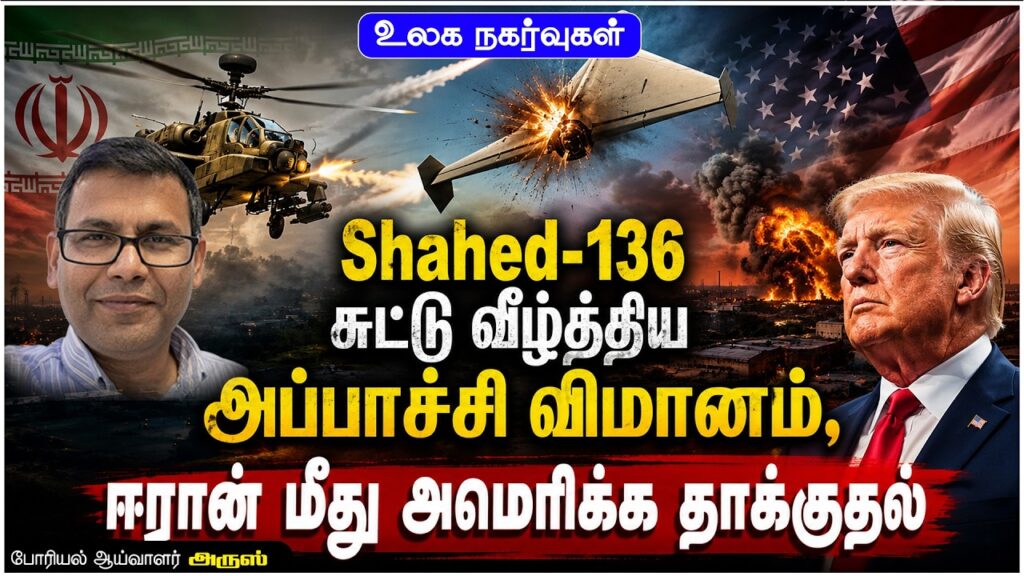
1. The Downing of the US Apache AH-64 over the Strait of Hormuz
A central flashpoint of this sudden escalation occurred on June 8, 2026, over the strategic Strait of Hormuz. A US Apache AH-64 attack helicopter—a premier $52 million military asset—disappeared from flight tracking radars while traveling at 194 km/h at an altitude of 1,000 feet.
While Western media initially cited potential mechanical failures, former US President Donald Trump and military channels have confirmed that the helicopter was shot down. Though both American pilots were safely rescued, the method of the downing points to a significant shift in regional warfare.
According to military intelligence, the Apache was not taken down by a traditional surface-to-air missile. Instead, it was intercepted in mid-air by an Iranian Shahed-136 kamikaze drone. Famously utilized as a primary tool in the Russia-Ukraine conflict, the relatively inexpensive $10,000 loitering munition successfully neutralized a multi-million-dollar American aircraft, altering the tactical calculus in the region.
2. Immediate US Retaliation and Maritime Friction
In direct response to the loss of the helicopter, the United States military initiated immediate retaliatory strikes. Iran’s Mehr news agency reported at least four massive explosions and heavy bombardment shaking the port region of Sirik. The US Central Command (CENTCOM) confirmed these bombings were targeted responses to deter further Iranian aggression.
This aerial clash follows intense maritime friction in the same waters. Just a day prior, a US F/A-18 Super Hornet targeted and disabled the engine of an Indian commercial vessel (MT Marivex), forcing the Indian military to deploy its own helicopters to rescue 24 Indian citizens aboard. The US actions highlight a strict enforcement policy aimed at preventing international buyers from purchasing oil through Iranian-controlled channels.
3. Hezbollah Crosses the Red Line into Israel
Simultaneously, the northern front of Israel has seen an unprecedented security breach. Despite diplomatic interventions to stall an all-out offensive in Lebanon, cross-border violence has surged. Over a 24-hour window, Hezbollah launched 18 coordinated strikes against Israeli positions.
Crucially, for the first time since the 2006 war, three Hezbollah operatives successfully infiltrated Israeli territory. While Israeli Defense Forces (IDF) killed one infiltrator during a firefight, the remaining two successfully evaded capture. This physical breach of Israeli borders, coupled with satellite imagery showing the total destruction of an aircraft hangar at Israel’s Ramat David Airbase by Iranian missiles, has put Israel’s defense systems under immense strain.
4. The Economic Front: Escaping the Petrodollar
Despite the heavy kinetic warfare, analysts suggest that the primary battle remains economic. The US strategy continues to focus on maintaining extreme economic blockades, attempting to force global powers like India and the European Union into long-term energy agreements tied strictly to US interests.
However, Iran has found sophisticated workarounds to Western banking restrictions. Iran has opened a fully functional parallel administrative and financial network for commercial shipping through the Strait of Hormuz. International vessels are currently paying transit taxes directly to Tehran. To completely bypass the US-controlled SWIFT banking system, these payments are being processed exclusively in Chinese Yuan (RMB), Russian Rubles, or Cryptocurrencies. Currently, an average of five massive vessels pass through daily under explicit Iranian authorization, showcasing a steady migration away from the traditional petrodollar.
5. Regional Realignment and India’s Evacuation Order
The longevity and scale of this conflict have prompted global superpowers to shift their diplomatic postures. Crucially, the Indian government has upgraded its travel advisory from a standard safety warning to an urgent request for its citizens to completely evacuate Middle Eastern nations wherever possible. Given the vast numbers of South Asian expatriates working in Gulf states, this preemptive evacuation underscores intelligence reports pointing to a protracted, expanding war.
With US assets repeatedly taking hits, there are ongoing strategic discussions within Washington regarding the relocation of permanent military bases out of the vulnerable Gulf region entirely, looking toward safer long-term hubs in Turkey, Cyprus, or Sri Lanka.
As Iran transitions its military posture from basic survival to active regional ambition—fully backed by technical and strategic consulting from Russia and China—the Middle East stands on the precipice of a fundamentally rearranged balance of power.
Credits and Acknowledgments
- Source Material & Commentary: This article is based on the comprehensive geopolitical analysis broadcast by Ilakku Web 2.0. We extend our gratitude to the network and their resident defense analyst, Dr. Arus, for the detailed updates.
- Media & Video Credit: The featured header image and accompanying video coverage are utilized courtesy of Ilakku Web 2.0. All rights reserved by the original creators.
You can watch the full broadcast directly via the embedded video below: